Congressional App Challenge entry

Immersive history should work everywhere.

OpenDoor VR is a browser-based delivery system for bringing immersive stories to phones, tablets, computers, and VR headsets—without an app-store download or one required headset.

Opens Pearl Harbor: Stories of Courage, the live proof of concept, on an external site.

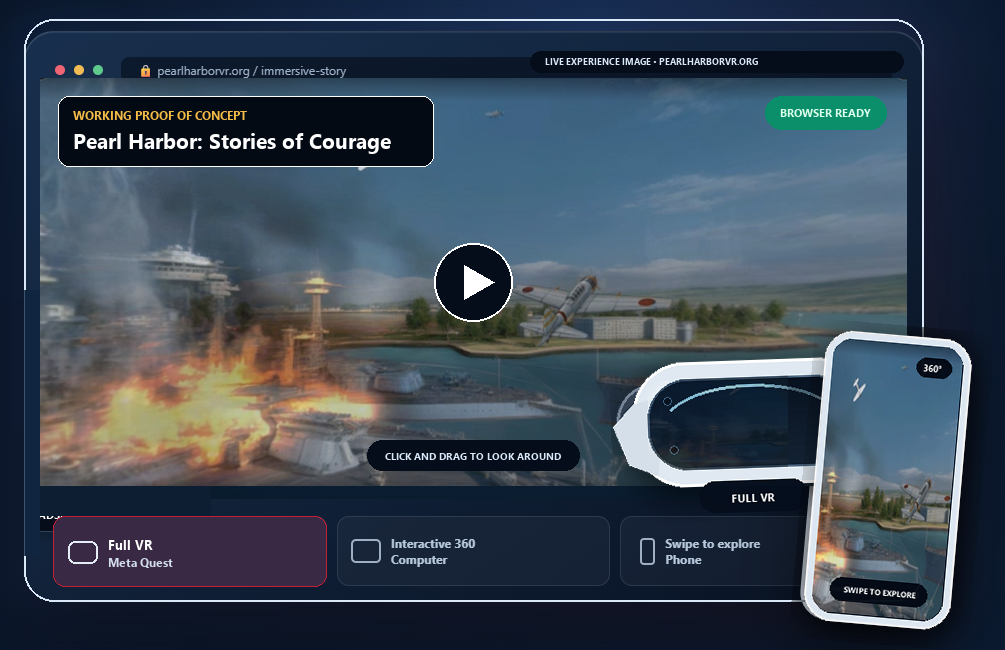
Approved OpenDoor VR competition visual showing Pearl Harbor: Stories of Courage on a computer, VR headset, and phone. Open the live working experience (opens external site in a new tab)

Approved competition visual · Live Pearl Harbor proof of concept

See the working proof

Start with what works

A real experience, already in the world.

Pearl Harbor: Stories of Courage is the deployed, approximately five-minute proof that the cross-device approach works.

Public launch

January 2026 Pearl Harbor National Memorial

The preview is stored locally. YouTube is contacted only after you select play.

In partnership with Pacific Historic Parks

Working proof of concept

Pearl Harbor: Stories of Courage

Built with A-Frame and Three.js, with an interactive 360° fallback when full XR is unavailable.

Launch
January 2026
Experience
Approximately 5 minutes
Delivery
Browser-based
Enter the live experience (opens external site in a new tab)

The access problem

Powerful stories should not stop at the headset.

Specialized hardware, app downloads, and device-specific builds can keep immersive history out of classrooms and homes.

OpenDoor VR uses one web address, then adapts the experience to the device a visitor already has.

Phone

Touch-first 360° viewing

Tablet

Shared exploration

Computer

Mouse and keyboard

VR headset

Full immersive mode

How OpenDoor VR works

One link. Three rendering paths.

The browser checks capabilities and selects the most reliable experience.

  1. 1 Open the link

    No app-store download

  2. 2 Check capabilities

    Graphics, XR, and input

  3. 3 Select a path

    Headset, desktop, or mobile

  4. 4 Enter the story

    Immersive or interactive 360°

01

Meta Quest

Native video texture + WebXR

Supported headsets enter an immersive session with head-tracked 360° video.

  • Native video texture
  • Controller and gaze-aware input
02

Desktop + laptop

Canvas texture + WebGL fallback

A canvas texture avoids black-video failures on some decoder and GPU combinations.

  • Interactive 360° scene
  • Mouse, trackpad, and keyboard
03

Phone + tablet

Lightweight Three.js viewer

A focused viewer avoids heavier startup work and mobile timeout risks.

  • Faster touch-first startup
  • Reduced runtime overhead

Local capability check

See what your browser can do.

Device Check examines only browser capabilities needed for an immersive experience. It runs entirely on this device and transmits no personal data.

Private by design No account. No upload. No tracking.

Enable JavaScript to run the interactive capability check. The rest of this site remains available.

Designed for more people

Accessible by design.

Non-headset participation is a first-class way to encounter the story.

Accessible presentation

Strong contrast, keyboard navigation, visible focus, reduced motion, and room for captions or transcripts.

Flexible participation

Visitors use the device and interaction method available to them.

Educator-ready value

One web link is easier to preview and share across mixed-device classrooms.

Portrait of Harrison Johnson.
Student founder · Young patriot Harrison Johnson Using technology to honor American heroes and preserve their stories.

From idea to public launch

  1. 01
    Four years of persistence

    I started this mission when I was younger and took it door to door.

  2. 02
    More than $110,000 raised

    Harrison's Heroes rallied a community to honor veterans and preserve history.

  3. 03
    Launched January 2026

    My first experience reached the Pearl Harbor National Memorial.

Authentic portrait and verified project milestones

Why I built it

I built this to honor our heroes.

I am still a student. I started this mission four years ago because I wanted the courage and sacrifice of American heroes to reach people in a way they could feel—not only read about.

Through Harrison's Heroes, our community raised more than $110,000 and helped make the Pearl Harbor experience possible. OpenDoor VR grows from that same patriotic mission: honor service, preserve history, and open these stories to the next generation.

Honor their courage. Preserve their stories. Open history to everyone.

Built responsibly

Open web technology, clear boundaries.

The implementation, privacy choices, use of AI, and next steps are stated plainly.

Technology + AI

Built on the open web

  • A-Frame and Three.js deliver browser-based 3D and 360° scenes.
  • WebXR enhances supported headsets; interactive 360° remains available.
  • AI assisted coding and review under human direction—not historical testimony, partnerships, or claims.

Privacy

No account. No tracking.

  • Device Check runs locally and transmits no personal data.
  • No sign-in, profile, upload, or analytics connection is required.
  • This project does not connect to Pearl Harbor production systems.

Credible next steps

Improve what is real

  • Expand physical-device and assistive-technology testing.
  • Refine performance across all three rendering paths.
  • Gather educator feedback before prototyping a second sourced story.

The doorway is open

Experience the proof.
Imagine the reach.

Visit Pearl Harbor: Stories of Courage (opens external site in a new tab)

External working experience · Opens in a new tab