Congressional App Challenge entry

Immersive history should work everywhere.

OpenDoor VR is Harrison Johnson's browser-based delivery system for bringing immersive stories to phones, tablets, computers, and VR headsets—without an app-store download or one required headset.

Opens Pearl Harbor: Stories of Courage, the live proof of concept, on an external site.

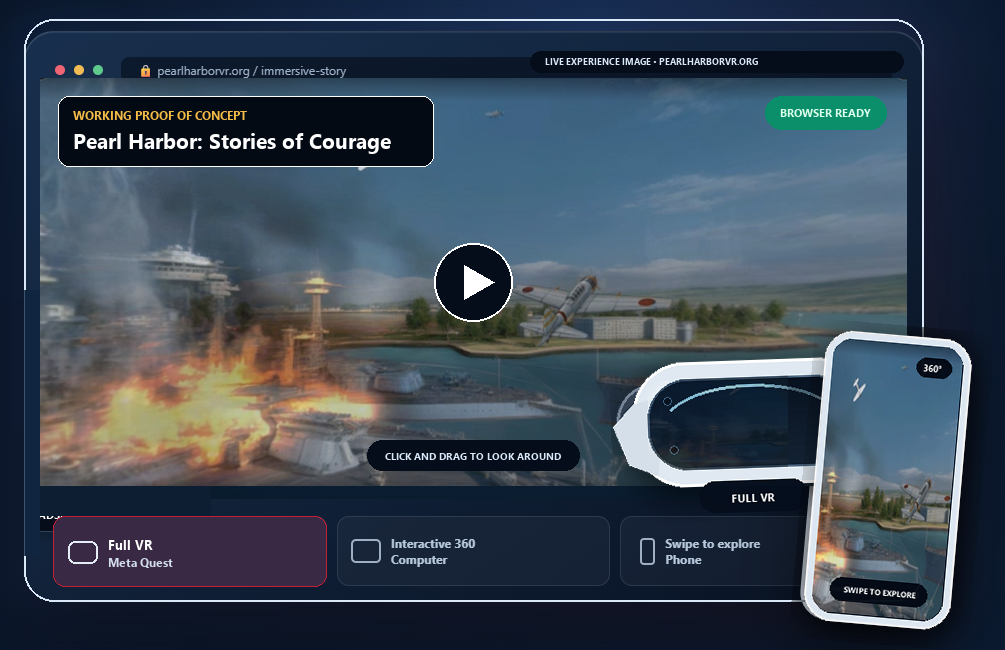
Approved OpenDoor VR competition visual showing Pearl Harbor: Stories of Courage on a computer, VR headset, and phone. Open the live working experience (opens external site in a new tab)

Approved competition visual · Live Pearl Harbor proof of concept

See the working proof

Start with what works

A real experience,
already in the world.

OpenDoor VR is not starting with a platform promise. It starts with Pearl Harbor: Stories of Courage—a deployed, approximately five-minute immersive experience that demonstrates the cross-device approach.

Public launch

JAN 2026
Launched at Pearl Harbor
National Memorial
In partnership with Pacific Historic Parks

Working proof of concept

Pearl Harbor: Stories of Courage

Launched in January 2026 at the Pearl Harbor National Memorial in partnership with Pacific Historic Parks. The experience uses A-Frame and Three.js and supports an interactive 360° fallback when full XR is unavailable.

Launch
January 2026
Experience
Approximately 5 minutes
Delivery
Browser-based
Enter the live experience (opens external site in a new tab)

The access problem

Powerful stories should not stop at the headset.

Immersive history can create presence and empathy—but specialized hardware, app-store downloads, and device-specific builds can keep it out of classrooms and homes.

OpenDoor VR uses the web as the common doorway. One address can meet a visitor on the device they already have, then choose an experience path that respects that device's capabilities.

Phone

Touch-first 360° viewing

Tablet

Larger shared exploration

Computer

Mouse and keyboard navigation

VR headset

Full immersive presentation

The OpenDoor approach

One story. Three rendering paths.

The browser identifies the environment and selects a practical path instead of forcing every device through the same heavy experience.

  1. 1 Open a web link

    No app-store download

  2. 2 Check capabilities

    Secure context, graphics, XR, input

  3. 3 Choose a path

    Headset, desktop, or mobile

  4. 4 Enter the story

    Immersive when possible, interactive always

01

Meta Quest

Native video texture + WebXR

On a supported headset, the browser can enter an immersive WebXR session and map 360° video directly into the scene for natural head-tracked viewing.

  • Immersive headset mode
  • Native video texture path
  • Controller and gaze-aware interaction
02

Desktop + laptop

Canvas texture + WebGL fallback

Some decoder and GPU combinations can produce black video textures. A canvas-based texture path provides a resilient fallback for interactive mouse and keyboard viewing.

  • Interactive 360° scene
  • Canvas texture compatibility path
  • Mouse, trackpad, and keyboard input
03

Phone + tablet

Lightweight Three.js viewer

A focused viewer avoids heavier startup work that can create timeouts on mobile, while preserving touch-driven exploration of the 360° story.

  • Faster mobile startup
  • Touch-first interaction
  • Reduced runtime overhead

Local capability check

See what your browser can do.

Device Check examines only browser capabilities needed for an immersive experience. It runs entirely on this device and transmits no personal data.

Private by design No account. No upload. No tracking.

Enable JavaScript to run the interactive capability check. The rest of this site remains available.

Designed for more people

Access is part of the experience.

Immersion is not only about putting on a headset. OpenDoor VR treats readable, navigable, non-headset participation as a first-class way to encounter a story.

Accessible presentation

High-contrast interfaces, keyboard navigation, visible focus, reduced-motion support, readable context, and room for captions or transcripts.

Flexible participation

Visitors can use the device and interaction method available to them instead of being excluded by a single hardware requirement.

Educator-ready value

A web link is easier to preview, discuss, and share across mixed-device classrooms than a headset-only installation.

A four-year journey

  1. 01
    Began as a child

    A personal idea to help history reach people differently.

  2. 02
    Went door to door

    Four years of persistence, learning, and community building.

  3. 03
    More than $110,000 raised

    Harrison's Heroes helped turn the idea into a real experience.

  4. 04
    Launched January 2026

    The first experience reached the Pearl Harbor National Memorial.

Verified milestones—not a portrait or concept image

The builder behind the doorway

Harrison started with a story worth sharing.

Harrison Johnson began this work as a child and spent four years taking the idea door to door—learning how persistence, community, and technology can help history reach people in a new way.

Harrison's Heroes raised more than $110,000. That community effort is part of the background that made the Pearl Harbor experience possible; OpenDoor VR is the technology direction growing from the lessons of that real-world work.

Build the doorway around the visitor—not the visitor around the technology.

Technology + responsibility

Built on the open web. Clear about the tools.

Experience technology

A-Frame + Three.js

The deployed Pearl Harbor experience uses established web graphics technologies to deliver 3D and 360° scenes directly in a browser.

Progressive delivery

WebXR + graceful fallback

Capabilities enhance the experience when available. They do not decide whether a visitor gets access to the story at all.

Responsible AI

Assistance, not invented history

This competition website was developed with AI-assisted coding and review under human direction. AI was not used to invent testimony, partnerships, or historical claims.

Privacy

Explore without becoming the product.

01

No account required

This presentation does not ask visitors to sign in or create a profile.

02

Checks stay local

Device Check reads browser capability signals locally and sends them nowhere.

03

No production connection

This standalone project does not connect to Pearl Harbor production systems, credentials, storage, databases, or analytics.

Credible next steps

Open the next door carefully.

The next phase is not a promise of a massive publishing platform. It is focused engineering and learning: test more real devices, document a repeatable production approach, listen to educators, and prototype another carefully sourced story.

  1. 01

    Expand physical-device and assistive-technology testing.

  2. 02

    Refine performance across the three rendering paths.

  3. 03

    Gather structured feedback from educators and visitors.

  4. 04

    Prototype a second historically responsible immersive story.

The doorway is open

Experience the proof.
Imagine the reach.

Visit Pearl Harbor: Stories of Courage (opens external site in a new tab)

External working experience · Opens in a new tab